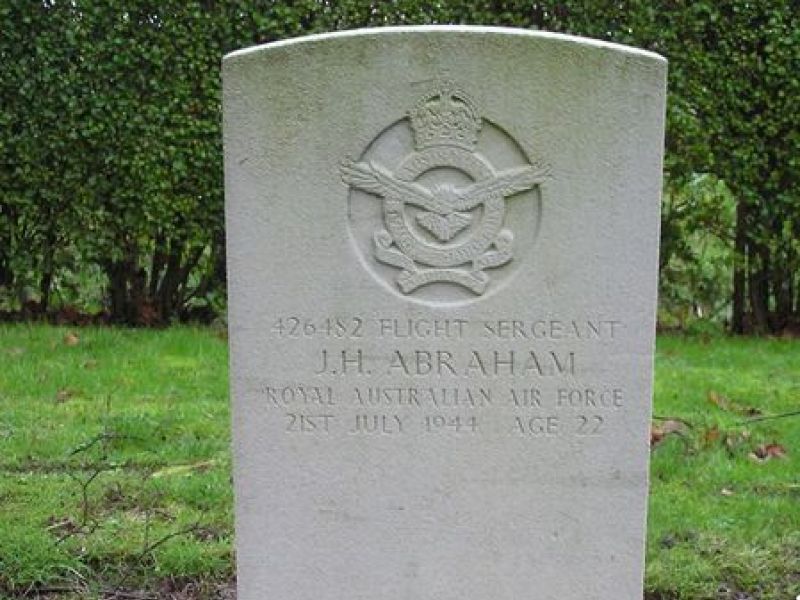
Flight Sergeant James Hedley Abraham, No. 467 Squadron, Royal Australian Air Force
 Australian War Memorial
James Abraham was born on 11 November 1927 in Blenheim, Queensland, to August and Minna Abraham. His father was a dairy farmer, and he had at least two brothers and three sisters. He was fond of tennis and cricket.
Abraham attended Manly State School and then Brisbane State High School. He received a first-class pass in arithmetic in his entrance exam for Queensland University, and studied accountancy with the firm Lightband and Donaldson. He found work as an office boy, and went on to become an audit clerk.
On 7 July 1942, Abraham enlisted in the Royal Australian Air Force, aged 20. He trained as an air bomber, and embarked at Melbourne for overseas service on 6 March 1943, arriving in Canada later that month. As part of the Empire Air Training Scheme, he was one of almost 27,500 RAAF pilots, navigators, wireless operators, air gunners, and flight engineers who, throughout the course of the war, joined Royal Air Force squadrons or Australian squadrons based in Britain.
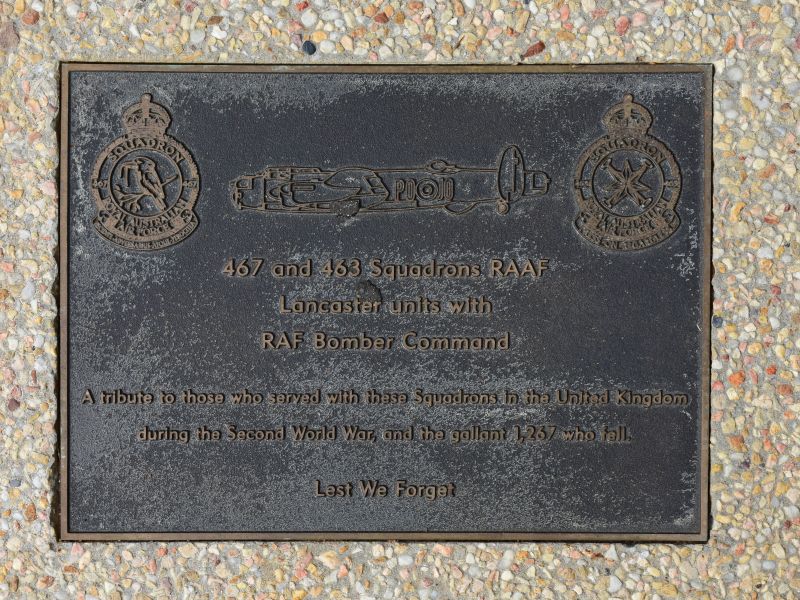
Abraham arrived in the United Kingdom in September 1943, and the following February was promoted to flight sergeant. In July he was posted to No. 467 Squadron, Royal Australian Air Force. As part of Bomber Command, the squadron flew the four-engined Avro Lancaster heavy bomber.
Just before 11.30 pm on the night of 20 July 1944, Abraham and his crew set off from Waddington, England, for a major raid on the railway centre of Courtrai in Belgium. The squadron committed 14 aircraft to the mission, and Abraham was the bomb aimer in Lancaster “PO-E”. Although the raid was ultimately a success, No. 467 Squadron lost two crews. One of them was Flight Sergeant Abraham’s. It failed to return to base, and it was later determined to have been hit by enemy fire.
In the Belgian village of Kaaskerke, witnesses saw the aircraft flying homewards at around 2 am on the 21st. It was in flames, and crashed three kilometres from the village church. There were no survivors. Also on board was British Sergeant Leslie Arcus and Australians Flying Officer David Barlow, and Flight Sergeants Edward Freame, Maurice Jones, Jack Ohlson, and Robert Scott.
The squadron’s wing commander wrote to Abraham’s parents to express his sympathy. He wrote:
“In the loss of your son the squadron has been deprived of an air bomber of great promise whose characteristic skill and courage inspired each one of us.”
After the war the remains of Commonwealth servicemen buried in Europe were examined and identified where possible. Abraham was identified, and buried with his crewmates at Kaaskerke. He was reinterred there under the inscription: “Blessed are the dead which die in the Lord.”
Flight Sergeant James Abraham’s name is listed on the Roll of Honour on my left, along with some 40,000 others from the Second World War.
This is but one of the many stories of service and sacrifice told at the Australian War Memorial. We now remember Flight Sergeant James Hedley Abraham, who gave his life for us, for our freedoms, and in the hope of a better world.
- Australian War Memorial Roll of Honour https://www.awm.gov.au/collection/R1705886