William Hugh (Bert) Lennox
 Stephen Learmonth
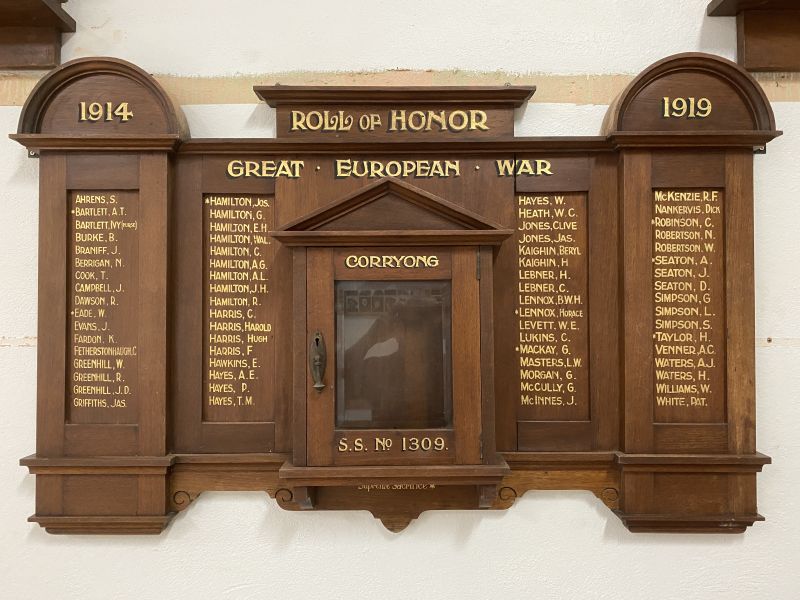
William Hugh (Bert) Lennox was born on 19th June 1893 in Corryong, Victoria, to Hugh Lennox and Margaret (nee Harris, nee Lennox) Dignan.
Upon enlistment on 14th December 1914 at Melbourne, Victoria, Bert was a 21-year-old, single, blacksmith living at 75 Bowen St, Moonee Ponds, Victoria. He stood 5 feet and 9 inches tall (175 cm) and weighed 11 stone and 5 lbs (72 kg). His complexion was described as fresh, with blue eyes and brown hair. His records show he had distinctive marks: a scar on the left cheek and another on the right forearm. His religious denomination was given as Presbyterian. Bert was allocated the Regimental Number 300 and put on strength with A Squadron of the 13th Light Horse.
Bert embarked on HMAT A34 Persic on 28th May 1915, sailing from Melbourne, Victoria. The trip would take him across the Great Australian Bight to Fremantle, on to Colombo, in Ceylon, before finally disembarking at Suez, at the southern end of the Suez Canal, in Egypt.
After an initial training period in Egypt, Bert embarked on HMT Megantic and joined the MEF at Gallipoli on 4th September 1915. Upon arriving on the Peninsula, the 13th spent some time at Shrapnel Gully becoming familiar with the fighting conditions. On 27th October, they relieved the garrison at Lone Pine, where they experienced a welcoming present of heavy shelling from the Turks. Other duties undertaken by the 13th included fatigue parties that carried supplies and materials to various parts of the front line. Finally, in December of 1915, the Allied Forces along the Peninsula evacuated their positions and returned to Egypt. Prior to the main evacuation, Bert had been admitted to the 5th Field Ambulance suffering from mumps. He was placed on board the Oxfordshire and sent back to Alexandria to recover.
After returning from the Dardanelles Campaign, the AIF underwent restructuring. The Infantry was expanded to four divisions while the 13th Light Horse was divided to provide a divisional cavalry squadron for the 2nd, 4th and 5th Divisions. Early in the new year, the 13th Light Horse was sent to join the BEF in France. Bert left Alexandria on 17th March, arriving at Marseilles on the south coast of France six days later. During mid-May, he was taken on strength with the 1st ANZAC Mounted Division.
Illness and injury, including a fractured fibula, resulted in Bert spending the next six months in either hospital or convalescent camps recovering. In late December 1916, Bert finally rejoined his unit in France and was promoted to Shoeing Sergeant the following month.
Leave away from the front line was always welcomed by the soldiers. In some cases, it was so welcome that they overstayed their leave pass. On 4th December 1916, Bert was found guilty of being AWOL (absent without leave) from parade. He was awarded 7 days confined to barracks. On 4th August 1917, he was given 11 days' leave in France, followed two months later by a similar period of leave in the United Kingdom.
While on the Western Front, the 13th Light Horse carried out a number of tasks, but the terrain and nature of the war limited their role as mounted troops. Tasks such as traffic control, rear-area security, prisoner escort duties, and, when weather and terrain permitted, reconnaissance.
Bert embarked on the SS Zealandia on 11th May, 1919, bound for Australia. He would be discharged on 30th September of that year. For his service in World War 1, Bert was awarded the 1914/15 Star, the British War Medal and the Victory Medal.
Bert married Alice Fraser on 21st April 1922. He passed away on 3rd November 1958 in Melbourne, Victoria and was buried in Springvale Botanical Cemetery, Victoria.