Bryan Lambert Burke
 Stephen Learmonth
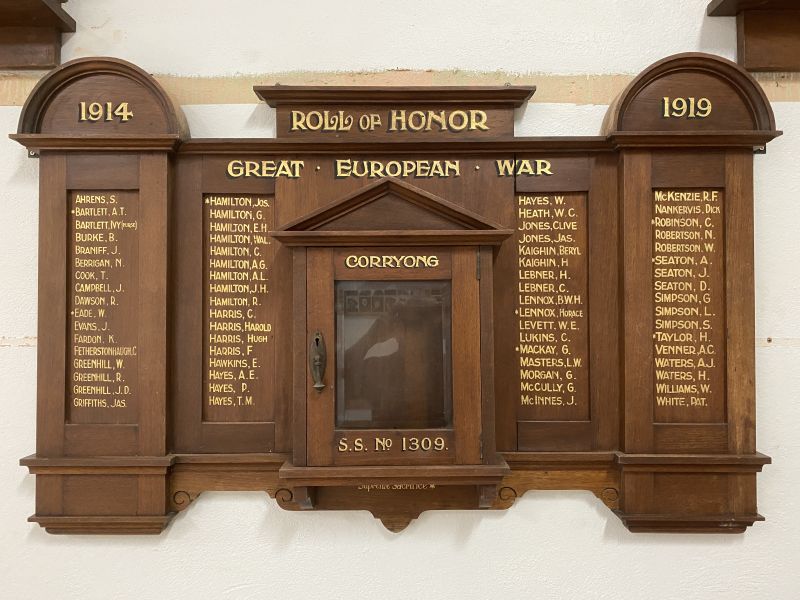
Bryan Lambert Burke was born in 1894 in Katamatite, Victoria, to John Lambert Bourke and Minnie, nee Aikenhead.
At the time of enlisting on 12th August 1915, Bryan was a single, 21-year-old overseer of a sheep station. His father, John, was working at the Bank of Australasia in Corryong at the time. His medical examination describes him as standing 5 feet 6 inches tall (168 cm) and weighing 140 lbs (64 kg). His complexion was described as fair, his eyes as blue, and his hair as light brown. His religious denomination was the Church of England, and he had no distinctive marks. Bryan was taken on strength with the 11th Reinforcements for the 1st Light Horse Regiment and was allocated the service number 1383.
On 4th October 1915, Bryan embarked on HMAT A47 Mashobra at Sydney, New South Wales and sailed for overseas service. Upon arriving at Heliopolis, Egypt, he joined his regiment. Early in the new year, Bryan sprained his ankle. He was placed on HMHS Rasheed and taken to Alexandria, where he was admitted to the 21st General Hospital. He was discharged from hospital a few weeks later.
On 6th July 1916, he was transferred to the Double Squadron at Serapeum. This was a dismounted squadron formed for the defence of the Suez Canal.
On 24th August, he was admitted to the 24th Stationary Hospital, being seriously ill with bronchial pneumonia. It would be late October before he had sufficiently recovered to rejoin his unit at Moascar. In late November, he was detached for duty with the 1st Light Horse Brigade Headquarters, remaining there for about one month.
For the first nine months of 1917, Bryan was on duty with the 1st Light Horse Regiment. During this time, the Regiment was part of the Allied advance across the Sinai. Bryan would have been present for the fight to secure the Turkish outpost at Rafa on 9th January. After this, his duties would have included protecting the lines of communications through the Sinai. The Regiment was also involved in the 2nd Battle of Gaza, where Allied forces aborted their attack after suffering heavy casualties.
On 4th September 1917, he was sent to the School of Instruction at Zeitoun to undergo a course on the use of the Hotchkiss machine gun. He rejoined his unit and was classified as a 1st-class gunner.
From October 1917 to mid-May 1918, Bryan remained with the 1st Light Horse. During this period, the Regiment was involved in the attack on Beersheba. It was while this battle was taking place that Gaza was finally captured, and the Turkish position in southern Palestine collapsed. The 1st Light Horse, and therefore Bryan, participated in the advance to Jaffa and the clearing and occupation of the west bank of the River Jordan. He would have been involved in the Amman (24th to 27th February) and Es Salt (30th April to 4th May) raids.
On 17th May 1918, Bryan was admitted sick to the 26th Casualty Clearing Station and then the 36th Stationary Hospital at Gaza. In 1918, Bryan was admitted to various hospitals and convalescent depots to recover from illness, although his records do not state the nature of the illness. He would rejoin his unit for short periods of time and be promoted to Lance Corporal.
Bryan returned to Australia on HMNZT Ulimaroa on 13th March 1919, and was discharged from the AIF on 28th September of that year. For his service during the war, he was awarded the British War Medal and the Victory Medal.
Bryan married Mabel Christina Wilkins in 1929. He passed away on 31st January 1969 at Prahran, Victoria and was buried in St Kilda Cemetery, St Kilda, Victoria.