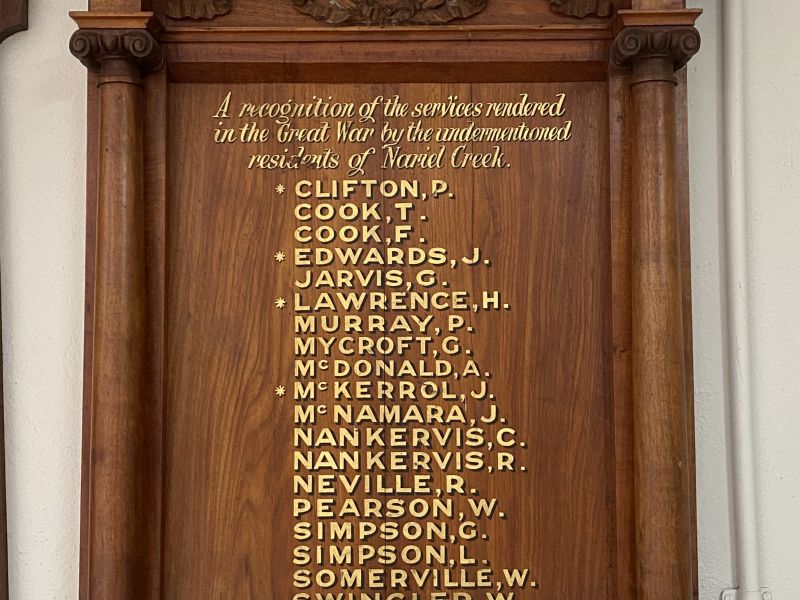
Frederick Charles Cook
 Stephen Learmonth
Born on the 24th of July, 1894, at Aston, Warwickshire, England, Frederick Charles Cook was the second youngest of eight children of Richard and Susan née Bradford. At the time of his birth, his family lived at 18 Sydney Road, Aston, in the West Midlands of England. Fred’s father, Richard, had previously served as a private in the 17th Leicestershire Regiment, having fought in the Afghan War between 1878 and 1880.
At 16, Fred lived in his family’s home at 18 Sydney Road and worked as a factory hand at B Masons & Sons, a factory in Wharf Street, Aston, producing copper alloy strips. It is not precisely known when Fred immigrated to Australia. The only passenger record showing a Frederick Cook is from the SS Cassel, which berthed in Melbourne in October 1912. Fred’s mother passed away on 14th April, 1915, although it would have been some time until he heard this news, as he would have been in Australia by this time.
On 7th January, 1916, Fred wrote a letter to his eldest sister, Elizabeth, whom he affectionately called ‘Tot’. In it, he tells her he is about to enlist and that he is sorry to hear about his brother, Ernest. (Ernest Stanley was a lance-corporal in the 8th Battalion of the King's Royal Rifle Corps and was killed in action on 30th July 1915, at Hooge Chateau, north-east of Ypres, in a battle that, for the first time, saw the German army use flamethrowers against the English forces.) He also explains that he intends to make out his will to her in case something happens. Lastly, he tells Tot that he has been lucky so far, earning 10 shillings a day by harvesting around Corryong for the past three weeks.
Fred enlisted at Seymour, Victoria, on 11th March, 1916. He was allocated to the 17th Reinforcements to the 8th Battalion and given Regimental Number 5361.
Fred’s second letter to Tot was written on 12th March, 1916, from the Methodist Soldiers' Tent at the Broadmeadows training camp just outside of Melbourne. While the letter is short, he explains how someone named Mack has joined the Red Cross instead of the Infantry, as he “got cold feet”. He indicates that although little interest is happening at the moment, he suspects they will be embarking overseas in about six weeks. He also asks what she thought of the photograph he had sent her in a previous letter.
While aboard HMAT A14 Euripides at sea, Fred wrote to Tot again. He explains that the officers won’t allow them to write anything about the ship or their destination. However, he mentions that the trip has been rough and that, while many men have been seasick, he has been fine. He warns Tot not to mention how he has left everything in his will to her, as his Aunt Lizzy would ‘cry out’ about him not leaving anything to his father. A cryptic comment of “I please myself and understand things better now, you know what I mean” indicates a possible rift in family relationships.
On 14th May, 1916, the 17th Reinforcements disembarked at Suez in Egypt. The next few months were spent training before they embarked again, arriving in England on 21st August and being stationed at Perham Downs Training Camp. He wrote another letter to Tot to let her know that he had arrived in England safely and how pleased he was to have been met by Lucy (another sister) and Teddy (Elizabeth’s husband). He explained that he had fixed all of his banking and will details. He mentioned that he thought his battalion wouldn’t be heading overseas to France for a while and that they would be stationed at Epsom, near London. Finally, he told her that the fat bacon she had sent him had gone down well but that he would “wait until we get a poor meal before I eat the fish then I shall enjoy it.”
Fred and his mates were only in England for a few days before they were sent overseas to France. Perhaps his comment about remaining in England longer was written to comfort his sister, who had already lost a brother in the war. He arrived at Etaples in northern France on the 23rd of August, then spent the next two weeks in training at the 1st Australian Division Base Depot before finally joining the 8th Battalion, 2nd Brigade, 1st ANZAC Corps, on 10th September, 1916.
At the beginning of November 1916, the 8th Battalion was in the Pommiers Camp, about 10 kilometres from the front line at Gueudecourt. The cold, wet winter had set in by now, and as the battalion moved up to the front, they walked in mud up to their knees and, in some spots, their waists. The combination of cold, constant rain, mud and heavy shelling every half an hour made life extremely difficult in the trenches, with many suffering from exposure. On 6th November, a particularly heavy bombardment rocked the trenches, resulting in Fred’s death, along with Privates Hanlon, Moore and White. A further 14 were wounded.
Fred has no known grave. He is remembered at the Villers-Bretonneux Memorial, Villers-Bretonneux, Picardie, France. For his service during the First World War, he was awarded the British War Medal and the Victory Medal.
- Roll of Honour, Australian War Memorial https://www.awm.gov.au/collection/R1713104