George Allan Jeffries
 Stephen Learmonth
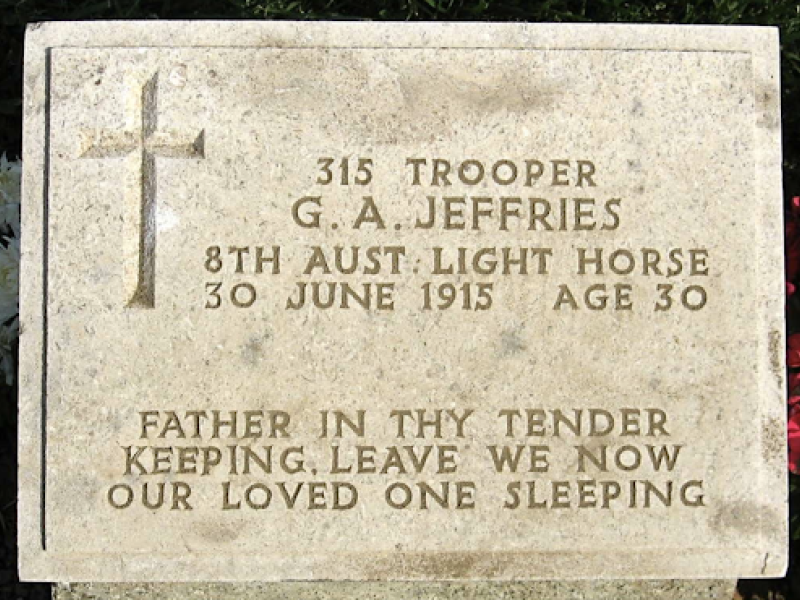
George Allen Jeffries was born in 1885, at Tocumwal, NSW, to George Rutherford and Anna Miller (née Forsyth) Jeffries. He was one of six children in the family. During his early years, he attended the Tocumwal Public School. According to the 1914 Australian Electoral Roll, George was a clerk in a railway construction office in Bruthen, Gippsland.
On the 17th of September 1914, George enlisted in the Australian Imperial Forces in Melbourne, Victoria. He was given Regimental Number 315 and was put on strength with B Squadron of the 8th Light Horse Regiment. Upon enlistment, George was a single, 28-year-old paymaster involved in railway construction. He was 180 cm tall and weighed 88 kg, with a fair complexion, blue eyes, and brown hair. George’s records show a mole on his upper right arm. His religious denomination was given as Methodist.
After initial training at the Broadmeadows camp near Melbourne, George embarked on HMAT A16 Star of Victoria on the 25th of February 1915, sailing from the Port of Melbourne. The trip would take him across the Great Australian Bight to Fremantle, on to Colombo, in Ceylon, before finally disembarking at Suez, at the southern end of the Suez Canal.
George had not been in Egypt long before he was admitted to the No. 2 General Hospital at Mena on the 7th of April, suffering from influenza. On the 16th of May 1915, the 8th Light Horse Regiment embarked on the SS Minominee at Alexandria, bound for the Gallipoli Peninsula. Due to the heavy casualties suffered by Allied forces in the Dardanelles, the Light Horse Regiments would be sent over to fight as infantry. While many of the troopers were disappointed not to take their horses, they were desperate to have a go at the Turks. The 8th disembarked from their transport onto HMS Foxhound, an English destroyer that would take them closer to the beaches. They landed at ANZAC on the 21st of May, 1915.
On the 9th of June, George’s father passed away at his home in Brunswick Street. It’s unknown if George knew of this before the action on Walkers Ridge.
On the 29th of June, the 8th Light Horse was manning the trenches on Walkers Ridge when Turkish artillery opened up with heavy fire. This lasted approximately 30 minutes, after which the Turks opened with heavy rifle fire for another hour. At 0015 hours, the Turks attacked the trenches, but the 8th and 9th Light Horse held them back and prevented them from entering the Australian trenches. One sergeant, one corporal, and four troopers, of whom George was one, were killed during the attack. He was buried at Ari Burnu Cemetery, Row E, Grave No 2, Gallipoli, Turkey, with Rev. E Merrington taking the service.
Eventually, George’s family would receive a brown paper parcel containing all his personal effects. These included a pipe, a mirror, a prayer book, poems, and a comb. He also received glasses in a case, two razors, shaving soap, a brush, two pocket knives, two coins, a purse, four handkerchiefs, a medal, a tobacco pouch, a chain and a bundle of letters.
While little is known about George’s family before or after the war, a letter in his records indicates that he had at least one brother.
Railway Construction Office
Spencer Street
Melbourne
6. 10. 1920.
Dear Sir,
In reply to yours of 28th Ult. re my late brother, No 315 Trooper George Allan Jeffries, 8th L.H. Regt. his father and mother are both alive.
I notice from your communication that medals are handed over in order of relationship, father before mother, unless reasons for varying the procedure are stated.
My parents live together at 27 Murray Street Elsternwick and if you so desire, my father would willingly resign his claim so that mother should have the medals sent to her.
Trust your regulations will permit this.
Thanking you in anticipation
Yours faithfully
E.V. Jeffries
One wonders why it was so crucial for George’s mother to be sent the medals if both parents were living at the same address. Perhaps it was to help a grieving mother and allow her to have and hold something of her son that had been taken from her.
George is remembered on the Australian War Memorial Roll of Honour and the Tocumwal War Memorial. George’s name was also included on Soldier’s Avenue on Towong Road in Corryong. For his service during the First World War, he was awarded the 1914-1915 Star, the British War Medal and the Victory Medal.