George Morgan
 Stephen Learmonth
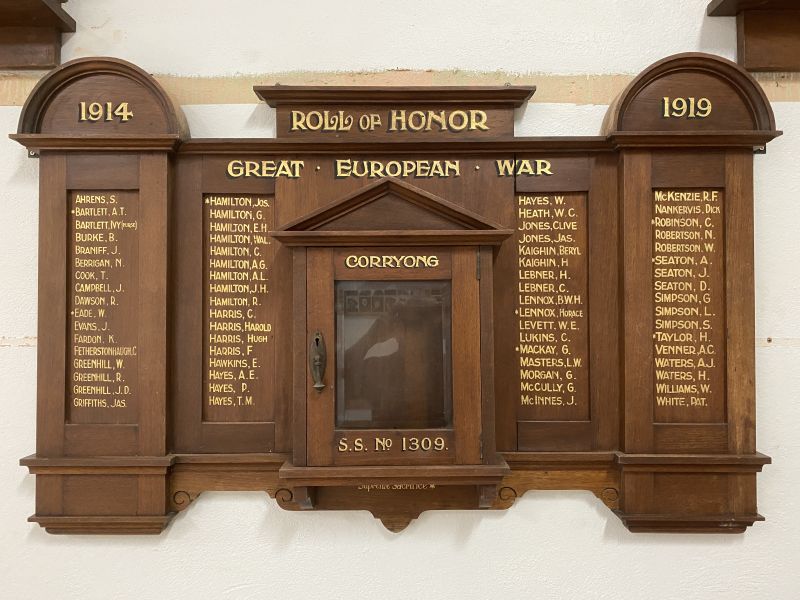
George Copland Morgan was born on 28th May 1899 in Corryong, Victoria, to Arthur Charles Vernon Morgan and Sarah Agnes, nee Whitehead.
On the 24th February 1916, he enlisted at Melbourne, Victoria. At the time, he was a single, 18-year-old typist from 3 Claremont St, South Yarra, Victoria. He was allocated Regimental Number 1702 and placed in the 2nd Reinforcements for the 60th Battalion. George gave his next of kin as father, Arthur. After initial training, he embarked on HMAT A17 Port Lincoln at Melbourne, Victoria, on 1st May 1916.
He disembarked from the Port Lincoln on 10th May at Suez and was transferred to Tel-el-Kebir. By late August of 1916, he was part of the 15th Training Battalion at Lark Hill in England. On the 1st day of September, he was apprehended by Military Police after being absent from camp for several hours. He was awarded three days' stoppage of pay.
On 21st October, he left for France. Two days later, he was admitted to the 4th General Hospital suffering from mumps. He was discharged on 15th November. On 27th December, it was discovered that George was underage, so he was sent back to England with all of the underage personnel. While stationed at No. 1 Command Depot, he decided to take another 24-hour personal leave. He was awarded another three days of confinement to barracks. George would tempt the authorities once more when, on the 25th May 1917, he took another 24 hours off. This time, he was awarded two days' confinement to barracks and the forfeiture of two days' pay. George clearly did not learn from his mistakes, so, on the 28th of June 1917, he was arrested and charged with being absent without leave from 10 a.m. on the 21st to 1.15 p.m. on the 28th of June. He was awarded six days of field punishment No. 2, forfeiture of 17 days' pay and placed in custody awaiting trial. On page 3 of his service record is written “A.W.L. from 2-7-17 till apprehended in Horseferry Rd London. When in lawful Custody attempting to escape. Pleading Guilty Finding Guilty Sentence to undergo detention for eighty (80) Days, 25-8-17.” Along with this sentence, he was required to forfeit 115 days’ pay.
George was not having the best of luck, for at this time he was diagnosed as having a venereal disease. He would spend the next 28 days in hospital. On 21st March 1918, George was transferred to the Overseas Training Battalion at Sandhill Camp near Longbridge Deverill, Wiltshire. On 10th April, he was sent to France, where he joined the 60th Battalion. In late July, he was admitted to the 2nd Canadian General Hospital but stayed only a week. In September, after a three-week stint in hospital for a ‘debility’, he was transferred to the 59th Battalion. One month prior to the signing of the Armistice, he was back in hospital suffering from scabies. One day before the end of the war, he was transferred again, this time to the 57th Battalion.
In 1919, before returning to Australia, he was admitted to hospital again, for scabies, had a two-week leave in England and was hospitalised for another 20 days with VD. Back at the AIF Depot in Tidworth, England, he was promoted to Corporal.
On 20th December 1919, he returned to Australia aboard HMAT A54 Runic, with the rank of Corporal. He was discharged on 31st March 1920, having been awarded the British War Medal and the Victory Medal for his service during the war.
George enlisted in the RAAF on 28th June 1944 and served as an equipment assistant until 19th September 1946. He spent 10 months in the AMF before enlisting in the RAAF.
George Copland married Margaret Cupit in 1930. The couple settled in Deniliquin, NSW, having one son, Eric, born on 13th December 1931. George gained employment as a tailor. He passed away on the 18th October 1953 at Koonoomoo, Victoria.