George Frederick Simpson
 Stephen Learmonth
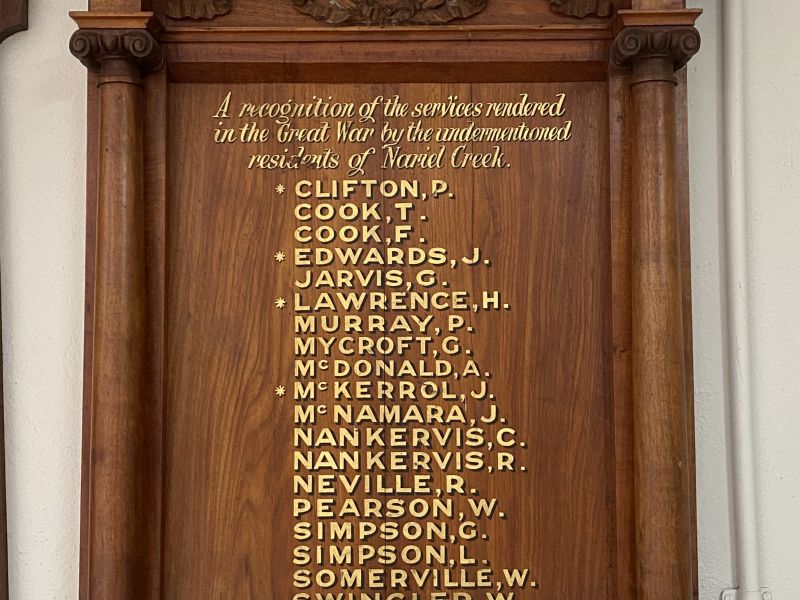
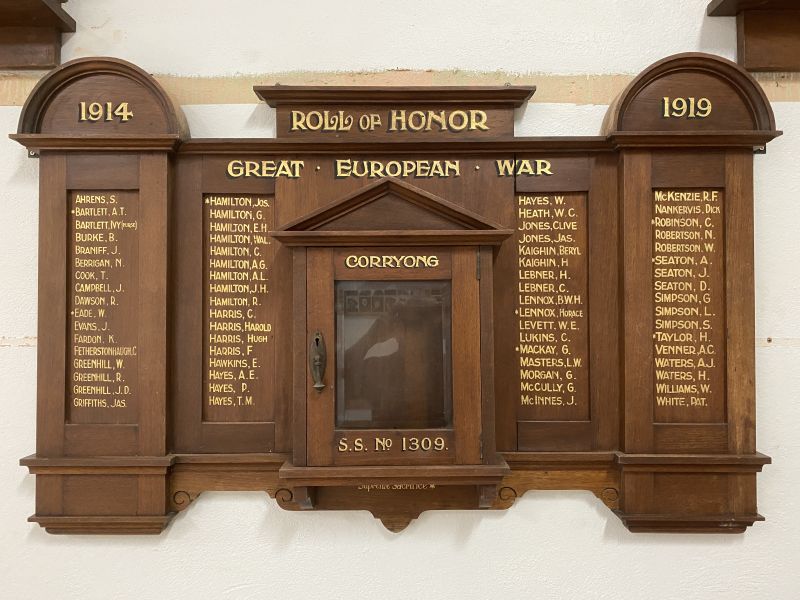
George Frederick Simpson was born on 10th January 1886 in Corryong, Victoria, to John Thomas Simpson and Annie, nee Nott.
In 1907, George went into business with Mr Marcus Buntz. As described in the 3rd October 1907 edition of the Corryng Courier;
“Wodonga. - The Federal Coach Factory (says the Sentinel) has changed hands. Messrs M. Buntz and George Simpson, two popular and efficient employees in the establishment, will separately have charge of the business. Mr Buntz will be responsible for the iron division; while the woodwork will be under the control of Mr Simpson. We understand that Mr Simpson the late proprietor, will go on his land at Tangambalanga. [The Mr Simpson referred to above is the fourth son of Mr John Simpson, of Nariel. He has many friends in this district who will wish him success in this enterprise.]”
George married Amelia Hester Harper at Wagga Wagga in 1910. Unfortunately, she passed away a few months after the wedding. In 1912, George sold his interest in the coach factory to Marcus.
On the 24th August 1914, George enlisted in Sydney, NSW. At the time, he was a widower, 28-year-old wheelwright living at the Fire Station, Wagga Wagga, NSW. He was allocated Regimental Number 316 and placed in Number 3 Battery of the 1st Field Artillery Brigade. George gave his next of kin as his mother, Annie Simpson. After initial training, he embarked on HMAT A8 Argyllshire at Sydney, NSW, on 18th October 1914.
George saw service on the Gallipoli Peninsula and the Western Front. While on Gallipoli, he was evacuated to Alexandria suffering from dysentery. Rejoining his unit on the Peninsula, George was promoted to Temporary Sergeant. He made it through the Gallipoli campaign unwounded. Approximately three months were spent back in Egypt, undergoing further training. He was not so fortunate on the Western Front, where he was wounded in action on 31st July by a gunshot wound to his right thigh. He was evacuated to England and admitted to Moreton County of London War Hospital. He would remain in hospital for two months, whereupon he was granted a two-week furlough in the UK.
In September of 1917, he was awarded the Military Medal for bravery in the field. Unfortunately, there is no record of the event date or of what George did to earn the award.
On 15th May 1919, he returned to Australia aboard HT Khyber, with the rank of 2nd Lieutenant. He was discharged on 15/07/1919, being awarded the Military Medal, the 1914/15 Star, British War Medal and Victory Medal for his service during the war.
Shortly before returning to Australia, George married Alice Ellen Wygold on 25th January 1919 at St Andrew’s Church, Plaistow, Essex. Arriving home in Corryong, an ANZAC Welcome Home event was organised on the 4th July 1919 for those soldiers just returned from overseas. George and his English bride were two of the honoured guests, as reported in the 10th July 1919 issue of the Corryong Courier.
“Lieut. George Simpson M.M., expressed his greatest pleasure and thanks for the welcome given. He had been at the landing of Gallipoli. He could thoroughly endorse what Lieut. Hanna had said about the work of the ladies. All the soldiers realised that the people at home were fighting their own battles. … He woud also thank the children for their work. … Lieut. Simpson was accompanied by his English bride. On arrival at the Hall the ladies of the Red Cross formed up in two lines along the centre of the Hall and at the end of the line Mrs Simpson was presented with a handsome floral basket of wattle by Mrs J Campbell, who in a few appropriate words extended the welcome of the district to her. …”
The October 1919 Electoral states that George was a patient at the Austin Hospital in Heidelberg, Victoria. The couple would eventually settle in the Geelong area, where George would gain employment as a motor body builder.
The couple would have at least two children. Alice passed away in 1963 in Geelong. George would live for another 27 years before passing away on the 21st June 1980 at Geelong, Victoria and was buried in Barrabool Hills Cemetery, Geelong, VIC.