John (Jack) George Walton
 Stephen Learmonth
Jack was born at the Rock, a small rural town just over 30 km from Wagga Wagga in NSW, in 1885. He was one of eleven children to Robert and Emma Florence (née Goodwin). The family had just moved to this area, having lived near Stawell in Victoria’s west, where the first of their eight children had been born. One of Jack’s brothers, Charles, had died when Jack was six, and Charles was only one. Three years later, in 1894, Jack’s mother, Emma, passed away.
Jack’s earlier education was at the Wagga Wagga Public School. After leaving school, he gained an apprenticeship as a jeweller with J McGowan at Coolamon, NSW, about 40 km north-west of Wagga Wagga. He remained with McGowan for six years before heading off on his own.
Travelling around the countryside, Jack found himself at Corryong. Articles in the Ovens and Murray Advertiserof 1907 provide us with an indication of Jack’s love of music and theatre.
14th September 1907
“At a poster ball held at Corryong last week the most original costume prize, lady and gentleman, was won by Mr. J. Walton and his wife (Mr L. Trapman), who were dressed in hessian, as the result of the tariff [the newly introduced Customs Tariff of 1907].”
14th December 1907
“The local dramatic club [of Corryong] staged the well-known drama “Aurora Floyd” on Friday. There was a very fair house and the play was well received …Messrs . Edwards, P. C. Hale, J. Walton, H Taylor and J. Hillard all acquitted themselves admirably …”
On 12th August 1915, Jack signed his enlistment papers at the Melbourne Recruiting Depot. He became Private J.G. Walton, Regimental Number 3962 of the 9th Reinforcements for the 23rd Battalion, 6th Brigade, 2nd Australian Division. He spent the first month of enlistment at the 22nd Depot Battalion before transferring to the 4th Depot Battalion at Royal Park. Murray McKay sent an article to the Corryong Courier, published on 16th September 1915, listing those from the Upper Murray who were with him in camp. From Corryong, they included Hugh Hamilton, Hugh Waters, Claude Robinson, Hugh Taylor, Jack Walton, Alex Waters, Guy Bailey and Geoff Bailey. Three of these men would never return to Corryong. Jack spent two more weeks at the 5th Depot Battalion before being transferred to the 14th Reinforcements for the 23rd Battalion, stationed at the Broadmeadows Camp near Melbourne, Victoria.
One of Jack’s older brothers, Robert Francis, also enlisted in the 1st AIF in the 55th Battalion. Although he was wounded twice during his service, he returned home in 1919.
It was well into the new year, on the 8th day of February 1916, when Jack and his unit embarked on HMAT Oriana at Port Melbourne and proceeded overseas. They arrived at Alexandria on 21st March and spent one week ashore before embarking on another troopship to take them the final part of the journey to the Port of Marseilles in the south of France. The troops spent three months at the 2nd Division Base at Etaples, undergoing more training for trench warfare at the front. Jack was finally taken on strength with the 23rd Battalion in the field at Rue de Bois, near the French-Belgium border, on the first day of July.
Within a month, Jack had been wounded in action with a shell wound to the right arm. He was taken to the 44th Casualty Clearing Station before being loaded onto No. 11 Ambulance Train. Two days were spent at the 4th General Hospital at Camiers before it was decided that Jack’s wound was serious enough for him to be taken to a hospital back in England. He embarked on HS Cambria at Calais and was admitted to the 1st West General Hospital at Fazakerley, Liverpool, by that evening. Jack would remain here until the 12th November when he embarked on the S.S. Victoria and returned to France, joining the 6th Training Battalion at Etaples. He rejoined his unit in the field on 6th December.
The winter of 1916/1917 in Europe was one of the coldest for decades. The trenches did not protect them from the bitter winter. Abnormally low temperatures, especially at night, froze clothes and blankets. The previously wet weeks had left the area a sea of slushy mud. Trench foot, caused by prolonged standing in cold and dirty water without changing boots or socks, affected thousands of troops on both sides of No Man’s Land. It was no surprise when Jack was admitted to the 13th Australian Field Ambulance with influenza on 3rd February. Within less than a week, he entrained on the 5th Ambulance Train and was admitted to the 12th General Hospital. Jack’s illness developed further into bronchitis, and he would remain in hospital until 12th April. He was then given a two-week furlough, but no records indicate what he did or where he went during this period. Upon returning, he was classified as B1A, someone who was capable of garrison duty overseas. He spent his final four weeks resting, regaining his strength until he was ready to complete basic training.
On 14th October 1917, Jack proceeded overseas to France, finally rejoining his unit on the 19th October. The new year once again saw him in poor health, and he was admitted to the 6th Australian Field Ambulance, suffering from scabies. A week in hospital left him sufficiently well to rejoin his unit in Belgium on 27th February 1918.
Towards the end of August 1918, the 2nd and 5th Australian Divisions were preparing to assault Mont St Quentin and Péronne. The village of Péronne was bordered on its southern and western edges by the Somme River. It was heavily fortified by the Germans. The Allies saw the village of Mont St Quentin as the key to Péronne. It stood at the top of a gentle slope and was a nest of trenches, machine guns and sentry positions manned by German soldiers who had volunteered to defend the Mont.
In the early hours of 31st August, the 5th Brigade of the 2nd Division set off on the initial assault of the Mont. By nightfall, they held a line on the south-western outskirts and had a foothold in the village. The brigade had taken nearly 400 casualties. The following day, the 6th Brigade of the 2nd Division entered the attack. The 23rd Battalion was in the lead. Upon reaching the area of Park Wood, they came under an intense machine gun attack. It was at this stage of the fighting that Jack was hit.
An account from Jack’s Australian Red Cross Society Wounded and Missing Enquiry Bureau files informs us of Jack’s last moments.
“At Mont St. Quentin, in the wood carrying machine guns he ran across an opening to get through; they were waiting for him and he was killed by machine gun. I was quite close to him, saw sparks fly off his helmet, he put his hand up to shield his face; hand was almost cut off. I did not see grave, but he was buried near Headquarters and I saw his cross ready to be put up.
Informant:- 7218 Cox, Ward 8, Harefield”
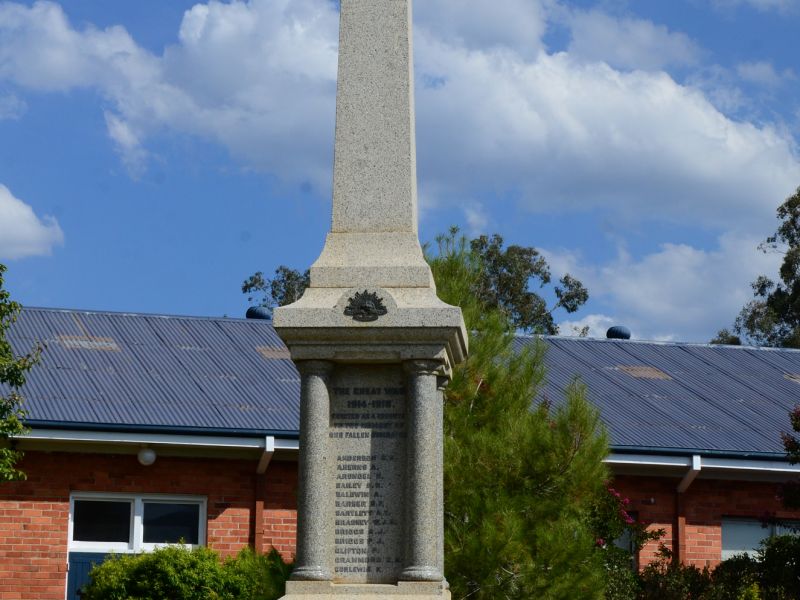
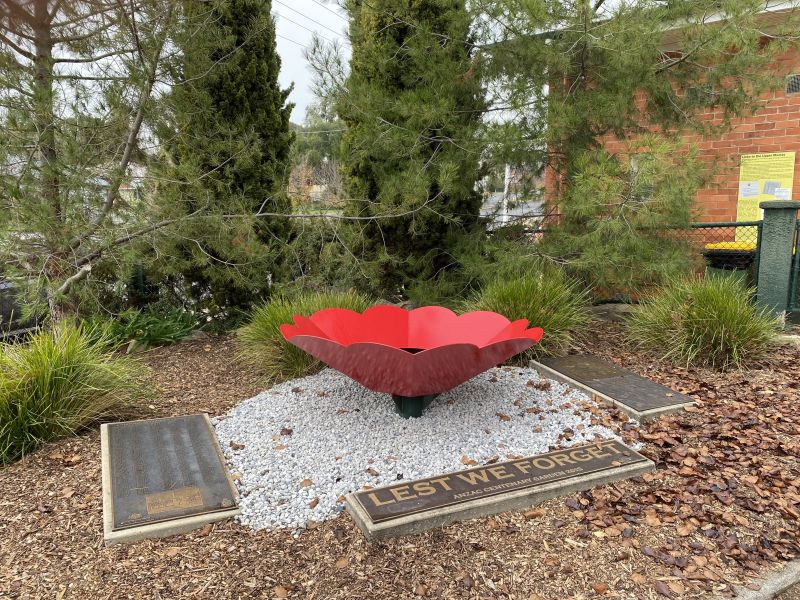
Jack was initially buried in the Clery British Cemetery, 23/4 miles north-west of Perone. After the war, he was reinterred in the Hem Farm Military Cemetery, Hem-Monacu, France. Jack is remembered on the Australian War Memorial Roll of Honour, the Leichhardt War Memorial, the Wagga Wagga Cenotaph, and the Corryong War Memorial. For his service, he was awarded the British War Medal and the Victory Medal.
General Lord Rowlinson, General Officer Commanding the British Fourth Army, of which the 2nd and 5th Australian Divisions were part, claimed after the battle;
“The capture of Mont St Quentin by the Second [Australian] Division is a feat of arms worthy of the highest praise. The natural strength of the position is immense and the tactical value of it in reference to Péronne and the whole system of the Péronne defences cannot be overestimated.
I am filled with admiration at the gallantry and surpassing daring of the Second Division in winning this important fortress, and I congratulate the with all my heart.”
- Roll of Honour, Australian War Memorial https://www.awm.gov.au/collection/R1668662