James Kinman Fardon
 Stephen Learmonth
James Kinman Fardon was born on 10th October 1888, at Adelong, New South Wales, to James Shaw and Catherine Mary, nee Malloy. He would be one of seven children.
On 5th October, 1914, James enlisted in the AIF at Rosehill, New South Wales. He was given the service number 350 and was put on strength with B Squadron of the 7th Light Horse Regiment.
Upon enlistment, James was a single 25-year-old labourer living at Appin South, near Kerang, Victoria. He was 5 feet 8 inches (173 cm) tall and weighed 9 stone 6 lbs (64 kg). His complexion was described as fair, his eyes as blue, and his hair as auburn. James had no vaccination scars, but he did have a scar on his left groin. His religious denomination was given as Roman Catholic.
James embarked on HMAT A33 Ayrshire on 19th December, 1914, sailing from Sydney. The trip would take him across the Great Australian Bight to Fremantle, on to Colombo, in Ceylon, before finally disembarking at Suez, at the southern end of the Suez Canal, in Egypt. The Regiment arrived in Egypt on 1 February, 1915, and in May was ordered to Gallipoli as a dismounted force. For a period of time, James and his unit were distributed amongst the battalions of the 3rd Infantry Brigade, although later it operated as a complete unit. The places that James would experience included Bolton’s Ridge, Tasmania Post, Chatham’s Post, Balkan Pits and Lone Pine.
On 9th September, James was admitted to the 1st Australian Casualty Clearing Station suffering from diarrhoea. This was a major problem with many soldiers on the Peninsula, on both sides of the trenches. The poor diet, lack of clean drinking water and the constant presence of flies that had fed on the decomposing corpses from previous battles resulted in more casualties being evacuated from the Peninsula than those who had been wounded. James had also developed a case of bronchitis and was evacuated from Gallipoli, initially to the Island of Mudros and finally to the No. 2 Australian General Hospital at Alexandria. James was also diagnosed with dyspepsia, a condition that caused severe abdominal pains and discomfort. Poor James must have gone through a terrible time health-wise, for early in the new year, he was once again admitted to hospital, this time the 4th Australian Hospital in Cairo, suffering from mumps!
It wasn’t until 13th March, 1916, that James was sufficiently recovered to be taken on strength with the 2nd Reserve Regiment, and he wouldn’t return to the 7th Light Horse at Tel-el-Kebir until 30th April. Once again, ill health struck, and James was admitted to hospital on 30th June, at Port Said, with an abdominal tumour and gallbladder complications, which may explain the previous condition of dyspepsia. This time, it was serious enough for him to be sent to the 3rd London General Hospital in England.
It was nearly ten months later that James was taken on strength by the 2nd Light Horse Regiment at Moascar. Approximately one month later, he was back with his old Regiment at Moascar before heading out into Palestine.
In September, he was admitted to the 24th Stationary Hospital at Kantara, this time suffering from influenza. After a week in hospital he was taken on strength at the 10th Rest Camp at Moascar. James underwent another transfer, this time on 28th May, 1918, to the Desert Corps Motor Workshops at Jerusalem.
On 31st October, 1918, James was once more admitted sick to hospital, initially to the 47th Stationary Hospital at Gaza and then, one week later, to the 24th Stationary Hospital at Kantara. This, along with the fact that he was one of “the originals”, led him to embark on the SS Port Darwin on 15th November, four days after the Armistice with Germany was signed, arriving back in Australia on Christmas Eve 1918. He was discharged as medically unfit (debility not stated) on 22nd February, 1919.
For his service during the war, he was awarded the 1914/1915 Star, the British War Medal and the Victory Medal.
James' records include a note dated 19th June 1919, in which he applied for free passage for his fiancée, Gertrude Newton, from England to Australia. There is little information about how James and Gertrude met, but one can only assume it was when he was in hospital in England.
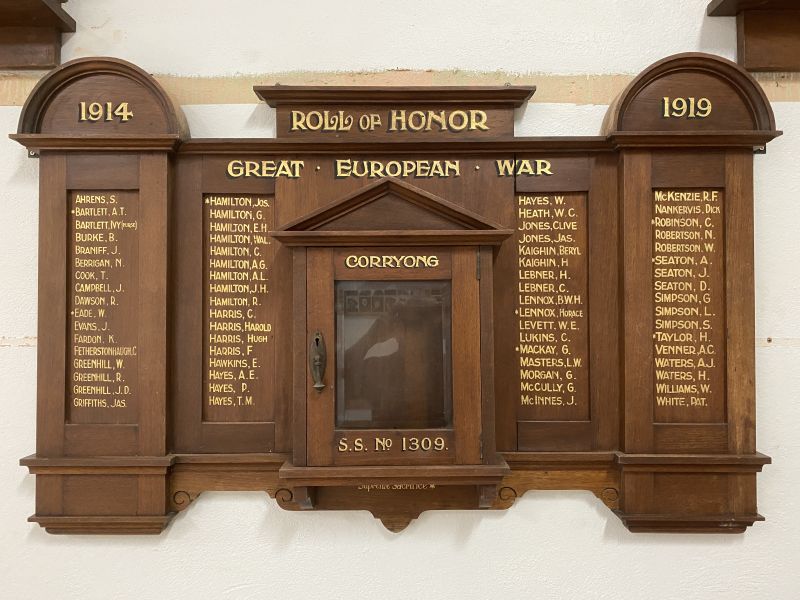
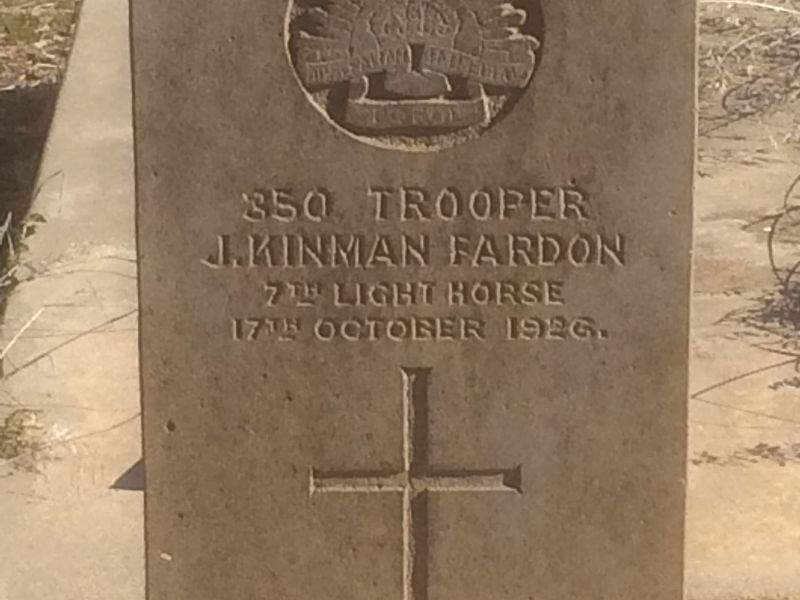
James and Gertrude Lilian Newton married in 1920. They had one son, Kinman Thomas James and two daughters, Myra and Joyce Kathleen Stott. James passed away on 17th October, 1926, only six years into their marriage, at Corryong and was buried at the Corryong Cemetery.
James’ death was reported in the 21st October 1926 issue of the Corryong Courier.
“General regret was expressed in Corryong and throughout the district on Monday, when it became known the Mr Ken Fardon had that morning breathed his last. Although not totally unexpected, the sad news was none the less keenly felt. Mr. Fardon, who was a highly respected resident of Tintaldra, served throughout the war, and experienced the horrors of Gallipoli. It was from the effects of the war that he patiently suffered from the time of his return until death relieved him as stated. Deceased was 38 years of age, and leaves a widow and two young children, for whom, with other members of the family, regret is inscerely expressed. …”