John James Edwards
 Stephen Learmonth
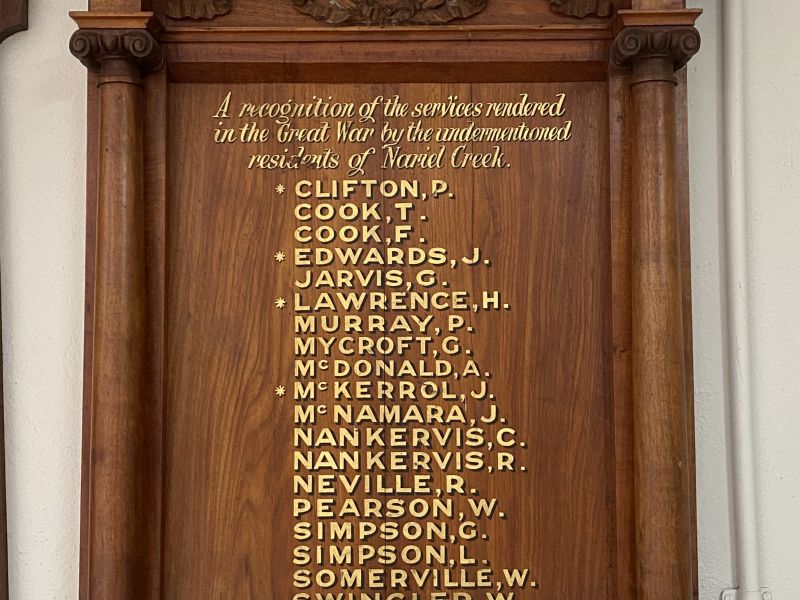
John James Edwards was born on 4th May 1888 in Albury, NSW, to John James Edwards and Caroline Elizabeth, nee Bennett.
On 6th May 1915, he enlisted at Liverpool, NSW. At the time, he was a single 27-year-old sawmill worker from Hanell St, Albury, NSW. He was allocated Regimental Number 708 and placed in B Company of the 18th Battalion. John initially named his brother, R. G. Edwards, as his next of kin, but this changed to his wife, Janet, after they married on the 18th July 1918.
After initial training, he embarked on HMAT A40 Ceramic at Sydney, NSW, on 25th June 1915. John would remain in the 18th Battalion for the entirety of his enlistment.
The battalion landed at ANZAC Cove on 22nd August and participated in the final stages of the August Offensive. In November, they were stationed at Courtney’s Post. John’s service record states that on 9th November, he was briefly admitted to the 5th Australian Field Ambulance. The next day, he was transferred to D Company as a reinforcement. The battalion left Gallipoli and moved back to Egypt, where they rested and refitted. In late March of 1916, it was transferred to France.
John was admitted to the 25th General Hospital suffering from dermatitis on 7th October. He was released on 22nd November. On 3rd May 1917, on the first day of Second Bullecourt, he was wounded in action with a gunshot wound to the back of his right knee. Within two days, he had been evacuated to a hospital in England. He would not rejoin the battalion until the 4th of October 1918. It was during this period of time in England that John married Janet Kathleen Barker on the 18th July 1918 at St Jude's Church, Southwark, London.
On the 17th of June 1919, John was informed that he had been awarded the Military Medal for his actions at Ommiecourt, France. His citation read:
“During the attack on a wood near OMMIECOURT-les-CLERY, West of PERONNE on the 29th. August 1916, a concealed enemy machine gun was holding up the advance of his platoon. This N.C.O. went forward alone and located it, and after throwing a bomb into the position, rushed the gun and killed the crew.
Later, he collected stragglers, and taking charge of them established a post on the flank of his company, thus making the position secure.
His courage and disregard for personal danger helped materially towards the success of the operation.”
On 20th June 1919, he returned to Australia aboard SS Konig Frederich August, with the rank of Sergeant. He was discharged on 10th October 1919, being awarded the Military Medal, the 1914/15 Star, British War Medal and Victory Medal for his service during the war.
Upon arriving from England, the couple settled in the Albury area and raised a family, with John working as a labourer. They would have nine children. During the Second World War, John enlisted in the Citizens’ Military Forces (V81068). John passed away on 27th July 1956 at Albury, NSW and was buried in Waugh Road Cemetery, North Albury, NSW.