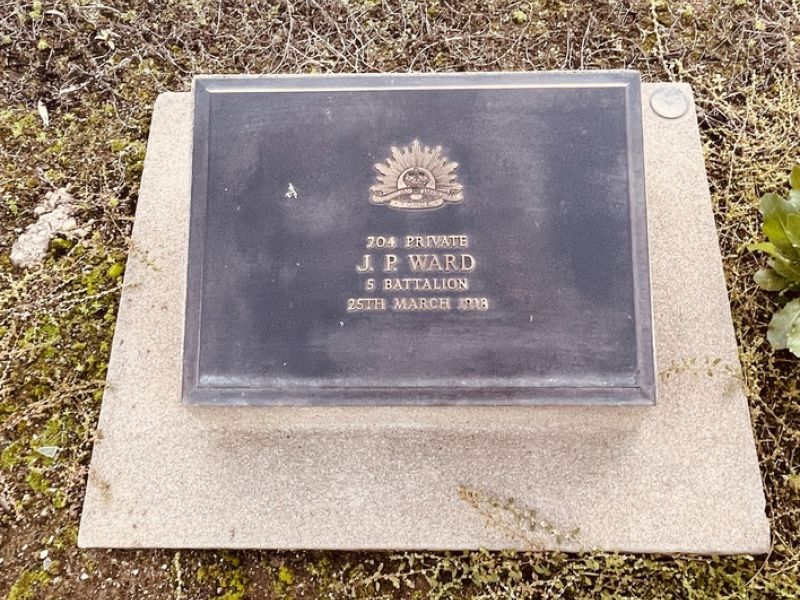
Joseph Patrick Ward
 Stephen Learmonth
Joseph Patrick Ward was born on the 23rd of March 1884 to John and Mary Ward of Ottawa, Canada. The Ward family moved from Canada to Australia when Joseph was around ten years old. The family settled in Whorouly, a small town approximately 20 km north-west of Mansfield in Victoria. A few months after the Ward family moved into the area in 1894, John, aged 40, drowned in the floodwaters of the Ovens River.
Sometime during the early years of the 20th century, Mary took her four children (Joseph, John, Michael and a daughter) to live in Wangaratta, Victoria, where they lived in Riley Street. It was here that Joseph took up the position of compositor for the local newspaper.
Joseph resided in Wangaratta for twelve years before moving to Corryong and taking up a similar position with the Corryong Courier. During his time in Corryong, he was noted as a keen player in local football and cricket, winning a goal-kicking medal for Corryong. It was in Corryong where he met Miriam Collins, the daughter of the late Thomas Collins and Johanna (née Carey) Collins of Corowa, NSW. Joseph and Miriam were married at the Corryong Roman Catholic Church on Monday, the 25th of July, 1913, the ceremony being performed by the Rev. Dr Flynn of Wodonga. According to the Friday, the 8th of August 1913 edition of The Corowa Free Press, “the happy couple received many useful and valuable presents”. The couple had two children during their short marriage: John and Bernard.
On the 15th of March 1916, Joseph enlisted in the AIF at Tallangatta, being allocated Regimental Number 704. By the 18th of April, he was appointed as a private in B Company of the 37th Battalion based just outside of Seymour. After three months of basic training, he embarked on HMAT A34 Persic at Port Melbourne, disembarking at Plymouth in England on the 25th of July, 1916.
Upon landing in England, Joseph was transferred to C Group of the 10th Training Battalion. This battalion had only just been formed and was stationed at No 3 Camp, Hamilton Lines, Larkhill, Salisbury Plain.
Billets consisted of the standard military bell tents, often called Sibley tents. Joseph would have shared his tent with up to fourteen other soldiers, including their equipment. Training consisted of specialised techniques needed in trench warfare, far different from the general soldiering skills learnt in Australia. The battalion remained here for three weeks before receiving orders to move to No 8 Camp at Codford, St Mary's, about 20 kilometres west of Larkhill.
After being at Codford for two weeks, practically all officers, including the commanding officer, Major Burrows, were ordered overseas. Joseph, along with the remainder of the battalion, was ordered to move once again to Nos. 2 and 3 Camps at Codford, St Peter. Unfortunately, due to transfers and reorganisations amongst other battalions, very little training was done during the next three weeks.
Finally, on the 23rd of September 1916, Joseph proceeded overseas to France and joined the Australian Division Base Depot at Étaples. Nearly three months later, he was taken on strength with the 5th Battalion, which was located near the small village of Buire (Buire-sur-l’Ancre), France, about 25 kilometres northeast of Amiens.
On the 3rd day of February 1917, Joseph was transferred to the 1st Australian Casualty Receiving Station, suffering from bronchitis. Over the next few days, he was admitted to the 9th General Hospital and then sent to the 2nd Convalescent Depot in Buire. After regaining his physical fitness and health, Joseph returned to the base depot, where he would have continued his training and attended refresher courses. He rejoined the 5th Battalion on the 12th of May.
In September 1917, the 5th Battalion took part in the Battle of Menin Road, the third of a series of battles that would make up the Third Ypres Campaign. The objective was to capture the high ground of the Gheluvelt Plateau east of Ypres to protect the right flank of the British Army advancing to the north. The 5th Battalion, as part of the 2nd Infantry Brigade of the 1st Australian Division, was assigned to the extreme right flank of the Australian advance. The battle was due to commence on the 20th of September. However, on the 18th, as battalions were moving up to take their places on the starting line, Joseph sustained a severe gunshot wound to his right arm. Within the week, Joseph was transferred from the 6th Australian Field Ambulance to the 7th Canadian General Hospital at Etaples and finally placed onto the HS (Hospital Ship) Stad Antwerpen. He disembarked in England on the 24th of September. He would spend the next six weeks at the Northern War Hospital before finally being transferred to the 1st Australian Auxiliary Hospital at Harefield in Middlesex.
Discharged from hospital on the 2nd of November, he was granted two weeks' furlough, reporting back to the depot at Hurdcott on November 16th. He spent two more weeks at the No. 3 Convalescent Hospital, where he was classified as B1A2 (fit for overseas training camp in three to four weeks). Joseph’s medical issues continued to plague him. A little over a week later, he was admitted to the Military Hospital at Fovant in Wiltshire, suffering from an inguinal hernia and varicocele (an enlargement of the veins in the scrotum). Throughout December 1917 and January 1918, Joseph was admitted to No. 3 Convalescent Home and then to No. 2 Convalescent Home. He was reclassified as Class C3 (permanently unfit for service) and left England for return to Australia aboard HMAT A14 Euripides on the 30th of January. Nearly two months later, he disembarked at the Port of Melbourne.
On Monday, the 25th of March, 1918, Sergeant Rohan of the Wangaratta Police found himself standing at the front door of a residence in Ryley St, Wangaratta. He was wondering how to break the tragic news to Miriam Ward and her two young sons that their husband and father had been found dead on the railway line between Burnley and Richmond East at 0800 hours that morning. After hearing the news, Miriam was beside herself, not only because of her husband's death but also because she was not even aware that her husband had returned home from England. She had received no notification from either Joseph or the Defence Department, and Joseph had been back in Australia for four days before he met his death.
The City Coroner’s Office made the following report;
“Sir,
Adverting to your memo of the 10th inst referring to the death of Private Patrick Ward - I have the honour to inform you that an Inquest was held on the 27th March 1918 at the City Morgue, Melbourne, when the Coroner, Dr Cole, found the following verdict -
On the 25th March 1918 at Richmond Patrick Joseph Ward was found dead on the Railway line near Mary Street Bridge having been run down and killed by a passing train. There is not sufficient evidence to show how he came to be on the line.”
Joseph’s body was forwarded to Wangaratta on the 27th of March, and he was buried in the Wangaratta Cemetery.
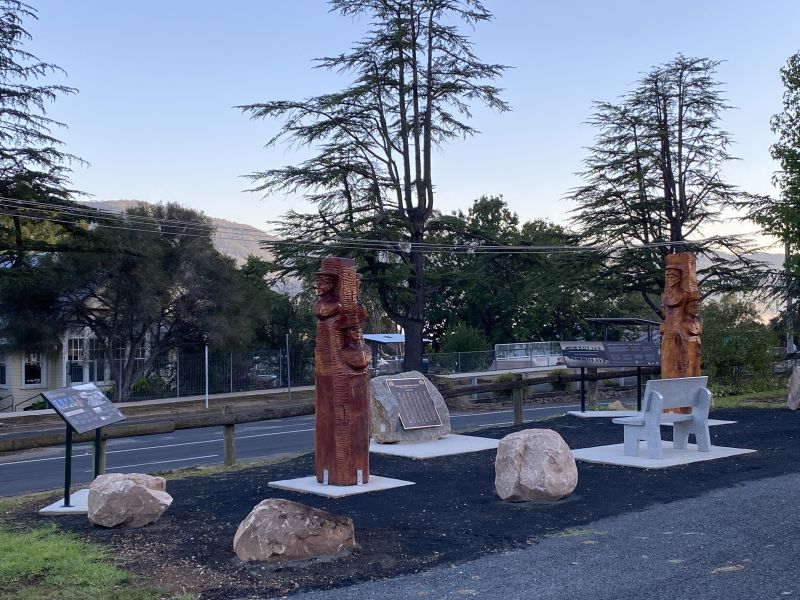
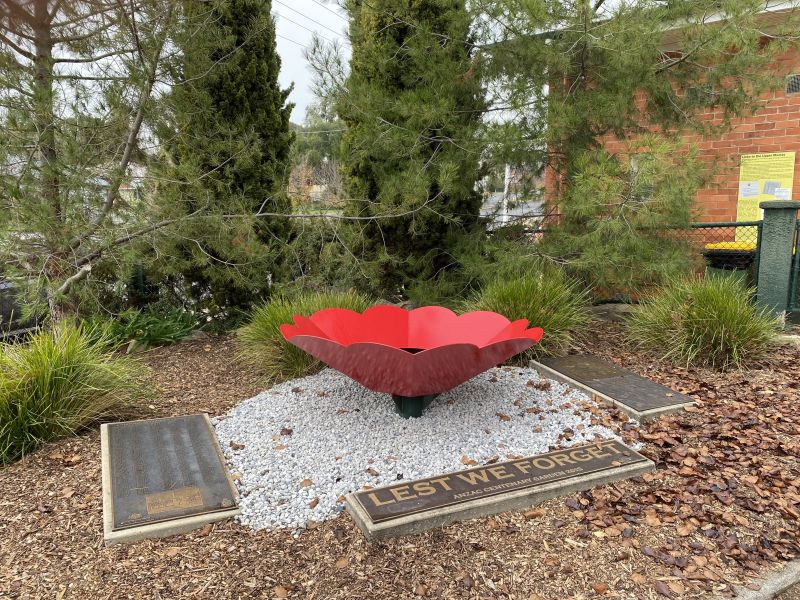
Joseph is remembered on the Australian War Memorial Roll of Honour, the Upper Murray Participants in the Great War Memorial plaque, and the Corryong and District Avenue of Honour Memorial. For his service, he was awarded the British War Medal and the Victory Medal